

Passive Income from Recon: Real Methods Hackers Use 🔍💰
Hi, I’m Vipul — the human behind TheHackersLog.
I’m a cybersecurity enthusiast passionate about ethical hacking, penetration testing, bug bounty hunting, and AI security. If you’ve been in this space for even a few months, you’ve probably noticed something: recon eats up more time than any other part of hacking.
So today I want to talk about something a lot of hackers don’t discuss openly — how to turn all that recon work into actual, recurring income. Not “get rich quick” nonsense. Real, sustainable methods that ethical hackers and security researchers are genuinely using right now.
Let’s get into it.
What you’ll learn in this guide
- What “recon” actually means in a security context
- Why recon skills are more valuable than most people realize
- Legitimate, ethical ways to earn passive or semi-passive income from recon
- Tools you can build or use to automate the process
- Common mistakes beginners make
- How to stay on the right side of the law while doing this
Quick note before we go further: everything in this article is about ethical, legal income streams. If a method involves scanning or testing a target without permission, I’m not covering it here — and you shouldn’t be doing it either.
What is “recon” in cybersecurity?
Recon (short for reconnaissance) is the process of gathering information about a target — a company, a domain, an app, or an entire organization — before any actual testing begins.
Think of it like a detective gathering clues before solving a case. You’re not breaking anything yet. You’re just observing, mapping, and understanding.
Recon usually falls into two categories:
- Passive recon — gathering information without directly interacting with the target’s systems (e.g., WHOIS lookups, search engine dorking, certificate transparency logs).
- Active recon — directly interacting with the target’s infrastructure (e.g., port scanning, subdomain probing). This always requires explicit authorization.
💡 Tip: As a beginner, get comfortable with passive recon first. It’s lower risk, teaches you a ton, and doesn’t require prior permission for public information.
Why recon matters so much
Here’s why this matters: in bug bounty hunting and penetration testing, recon is where most vulnerabilities are actually found — not through fancy zero-day exploits, but through overlooked subdomains, exposed panels, misconfigured cloud buckets, or forgotten staging environments.
A well-known stat that keeps circulating in the bug bounty community: a large share of valid bug bounty submissions come from assets that were discovered through recon, not from the “main” application everyone else is already testing.
In my experience, hunters who master recon consistently out-earn hunters who only know how to run automated scanners.
Why recon skills can become an income stream
Here’s the mindset shift a lot of people miss: recon isn’t just a “step before hacking.” It’s a skill set with standalone market value.
Companies, security teams, and other researchers are willing to pay for:
- Accurate asset inventories (what does an organization actually own online?)
- Attack surface monitoring (what changed since yesterday?)
- Automation tools that speed up recon
- Educational content that teaches recon
- Data-driven research and reports
Once you realize recon is a product, not just a task, a lot of income opportunities open up. Let’s go through the real ones.
Method 1: Bug bounty hunting (recon-focused approach)
This is the most obvious one, but most people do it wrong. Instead of jumping straight to testing, top hunters spend 70–80% of their time on recon alone.
How it works:
- Pick a bug bounty program (HackerOne, Bugcrowd, Intigriti, or private programs).
- Map the entire attack surface — subdomains, IP ranges, cloud assets, APIs, mobile app endpoints.
- Look for assets other hunters have missed (old subdomains, dev/staging environments, forgotten services).
- Test only what’s explicitly in scope.
- Report responsibly, following the program’s disclosure policy.
Recon techniques that actually work:
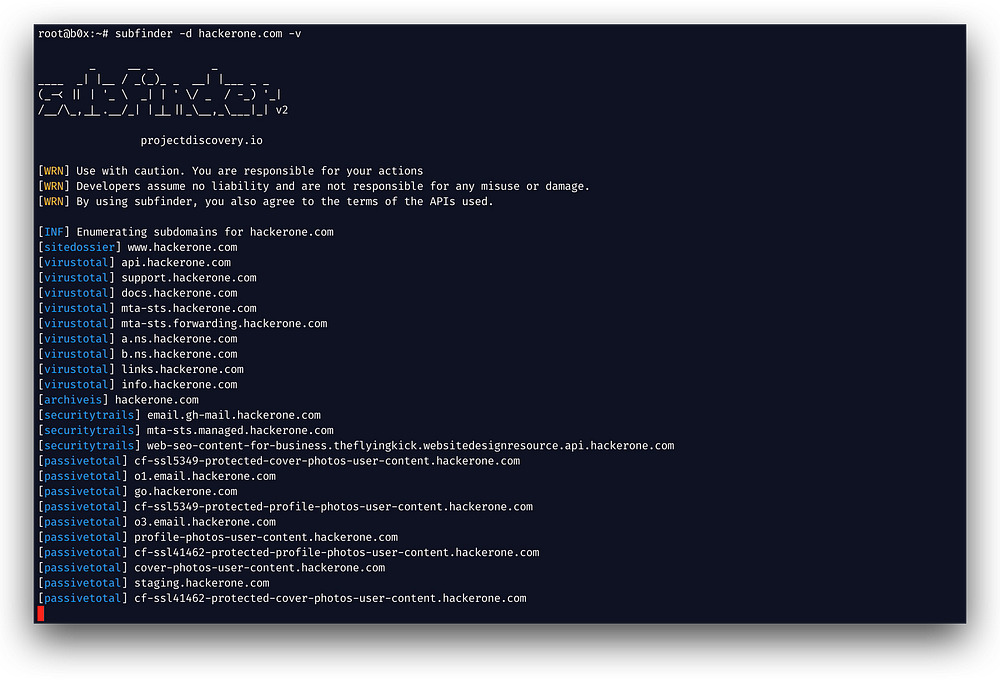
- Subdomain enumeration using tools like Subfinder, Amass, and Assetfinder
- Certificate transparency logs (crt.sh) to find subdomains issued SSL certs
- Google/Bing dorking for exposed files, login panels, and misconfigurations
- Wayback Machine / archive.org to find old, forgotten endpoints
- ASN and IP range lookups to map an organization’s entire infrastructure
- GitHub/GitLab dorking for leaked API keys or internal documentation
# Example: basic subdomain recon workflow
subfinder -d example.com -o subs.txt
httpx -l subs.txt -o live_hosts.txt
nuclei -l live_hosts.txt -t cves/ -o results.txt
⚠️ Warning: Always confirm the domain is in scope before running any active scans. Out-of-scope testing can get you banned from platforms or land you in legal trouble.
Is this “passive” income? Not fully — bug bounty is more “active income with recurring payouts.” But once you build a solid recon methodology and automation pipeline, your efficiency goes up dramatically, meaning more findings in less time. That’s where it starts to feel semi-passive.
✅ Best practice: Build a personal recon framework/script library once, then reuse it across every program. This is the single biggest time-saver experienced hunters rely on.
Method 2: Building and selling recon automation tools
This is where recon starts becoming genuinely passive.
If you’re good at scripting (Python, Bash, or Go), you can build tools that automate parts of the recon process and sell them.
What you can build:
- Subdomain enumeration wrappers that combine multiple tools into one pipeline
- Automated attack surface monitoring scripts (alerting when new subdomains/IPs appear)
- Recon report generators that convert raw scan data into clean PDF/HTML reports
- Custom Nuclei templates for niche vulnerability classes
- Chrome extensions for OSINT and recon workflows
Where to sell:
- Gumroad — great for selling scripts, templates, and mini-courses
- GitHub Sponsors — for open-source tools with a donation/sponsorship model
- Your own website — full control, higher margins
- Marketplace platforms for security tools and templates
💡 Pro tip: Package your tool with clear documentation and a short demo video. Buyers pay for convenience, not just code — most people could technically write the script themselves, but they’d rather pay to save time.
Real-world example: Several independent researchers have built and sold Nuclei template packs, recon automation frameworks, and OSINT dashboards on Gumroad and similar platforms. These aren’t massive companies — they’re solo hackers who packaged their personal workflow into a product.
❌ Common mistake: Building a tool that only works on your machine because of hardcoded paths or missing dependencies. Always test on a clean environment before selling.
Method 3: Teaching recon through content
This is one of the most sustainable long-term methods, and it compounds over time.
Formats that work:
- Blog articles (like this one) that rank on Google and bring consistent traffic
- YouTube walkthroughs showing real recon methodology (on authorized targets or intentionally vulnerable labs)
- Substack/newsletter breaking down weekly recon tips
- Paid courses on platforms like Gumroad, Udemy, or your own site
- Cheat sheets and templates sold as digital downloads
Why this becomes passive income: once an article, video, or course is published, it keeps generating value:
- Blog posts earn ad revenue and affiliate income long after publishing
- YouTube videos generate ad revenue on autopilot
- Courses sell repeatedly without you re-recording anything
- Newsletters build an audience you can later monetize through sponsorships
📊 According to industry surveys, cybersecurity content creators who consistently publish tutorials report their content-based income growing steadily over 12–18 months, even without daily posting once they build an archive.
How Hackers Actually Earn Passive Income With Recon
Hi, I’m Vipul 👋 — the human behind TheHackersLoginfosecwriteups.com
✅ Best practice: Focus on evergreen recon topics (subdomain enumeration, OSINT frameworks, attack surface mapping) instead of one-off news, since evergreen content keeps attracting search traffic for years.
Method 4: Attack surface monitoring as a service
This is a more advanced method, but it’s one of the fastest-growing niches in cybersecurity.
What it is: organizations often don’t have a full picture of their own internet-facing assets. Attack Surface Management (ASM) services continuously monitor a company’s domains, subdomains, IPs, and cloud assets for changes and exposures.
How hackers are monetizing this:
- Offering freelance ASM services to small and mid-sized businesses that can’t afford enterprise ASM platforms
- Building a simple automated monitoring dashboard using open-source tools and charging a monthly retainer
- Combining recon automation with alerting (Slack/Discord/email notifications) when new assets or exposures appear
A simple workflow:
- Set up scheduled recon scans (daily/weekly) using Subfinder, httpx, and Nuclei
- Diff the results against previous scans to detect new assets
- Alert the client when something new or risky appears
- Provide a monthly summary report
# Example: daily diff-based monitoring (simplified)
subfinder -d client.com -o today.txt
diff yesterday.txt today.txt > new_assets.txt
⚠️ Warning: This requires a signed authorization/contract with the client before any scanning begins. Never monitor a domain you don’t have explicit permission for — even “passive” recon on someone else’s infrastructure without consent can raise legal concerns depending on jurisdiction and method used.
💡 Tip: Start with businesses you already have a relationship with, or offer a free trial scan report to demonstrate value before pitching a paid retainer.
Method 5: Selling curated OSINT and recon datasets
This one requires more caution, but done ethically, it’s a legitimate niche.
Some researchers build and sell:
- Curated lists of publicly known vulnerable software versions (for defensive research)
- Structured datasets of publicly disclosed breach patterns (aggregated from public reports, not stolen data)
- OSINT methodology templates for specific industries
📌 Important: Never sell scraped personal data, leaked credentials, or anything obtained without authorization. That crosses from “recon business” into illegal data trading, and it can result in serious criminal charges. Stick to publicly available, non-sensitive, aggregated research data.
Method 6: Using AI to speed up recon (and monetize the workflow)
AI tools are changing how recon gets done, and this creates a new opportunity.
How hackers are using AI in recon:
- Using LLMs to summarize large recon outputs into readable reports
- Building AI-assisted recon assistants that suggest next steps based on scan results
- Automating report writing for bug bounty submissions
- Using AI to help triage which subdomains/endpoints are worth manual review
Monetization angle: you can build a lightweight AI-powered recon report generator and sell access to it, or offer it as a premium feature alongside your existing recon tools.
💡 Tip: Don’t rely on AI to find vulnerabilities blindly — use it to organize, summarize, and prioritize what your recon tools already gathered. Human validation is still essential.
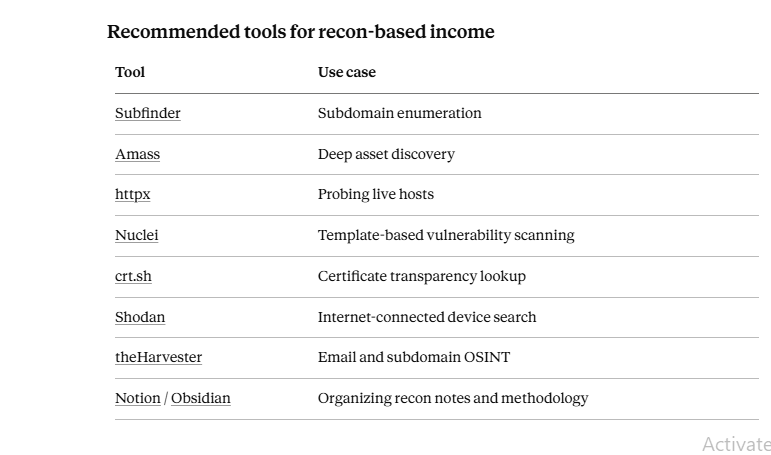
Recommended tools for recon-based income
Common mistakes beginners make
- Jumping straight into active scanning without checking scope or getting authorization
- Relying entirely on automated tools without understanding what they’re doing
- Not documenting recon findings, leading to repeated wasted effort
- Trying to monetize before building real skill and credibility
- Ignoring responsible disclosure policies when reporting findings
- Selling or sharing scraped data without verifying it’s legal and ethical
✅ Best practice: Build your skills and reputation first (through legitimate bug bounty work, writeups, or open-source contributions). Monetization opportunities tend to follow credibility, not the other way around.
Responsible disclosure: a quick reminder
If your recon leads you to a vulnerability, always follow responsible disclosure:
- Check if the organization has a published security policy or bug bounty program.
- Report through official channels only.
- Don’t publicly disclose details until the organization confirms a fix or agrees on a disclosure timeline.
- Never access, modify, or exfiltrate data beyond what’s needed to prove the vulnerability exists.
For more on this, OWASP and CISA both publish solid guidance on coordinated vulnerability disclosure. MITRE’s ATT&CK framework is also worth exploring if you want to understand how recon fits into the broader attack lifecycle from a defensive perspective.
Quick checklist before you start monetizing recon
- [ ] I understand the difference between passive and active recon
- [ ] I only test/scan assets I have explicit permission for
- [ ] I have a documented recon methodology or toolkit
- [ ] I know which platform (bug bounty, content, tools, services) fits my skills
- [ ] I understand responsible disclosure practices
- [ ] I’ve researched the legal boundaries in my country/region
- [ ] I have a plan to build credibility before pitching paid services
Key takeaways
- Recon isn’t just a step before hacking — it’s a skill with real, standalone market value.
- Bug bounty hunting rewards hunters who focus heavily on recon before testing.
- You can build and sell recon automation tools, templates, and Nuclei packs.
- Teaching recon through blogs, newsletters, and courses creates long-term, semi-passive income.
- Attack Surface Monitoring services are a growing niche for freelance security researchers.
- AI can speed up recon workflows, but human judgment is still essential.
- Everything in this space must stay ethical, authorized, and compliant with responsible disclosure practices.
Final thoughts
Don’t worry if this seems like a lot at first — it is. Nobody builds a recon-based income stream overnight. It usually starts with one skill (like subdomain enumeration), then grows into a toolkit, then maybe a blog post, then a small tool, then a service.
A common mistake is trying to monetize before you’ve actually built real recon skills. Focus on getting good first. The income opportunities show up naturally once you have something valuable to offer — whether that’s knowledge, tools, or a service.
Stay curious, stay ethical, and keep testing responsibly. 🔐
Continue learning with TheHackersLog
If this helped you think through your own security career, I’d love to have you stick around:
- 🌐 Website: thehackerslog.com
- 📬 Substack Newsletter: thehackerslog.substack.com
- 📚 Gumroad Store: thehackerslog.gumroad.com
Thanks for reading — and as always, hack ethically, learn constantly, and share what you learn. 🛡️


